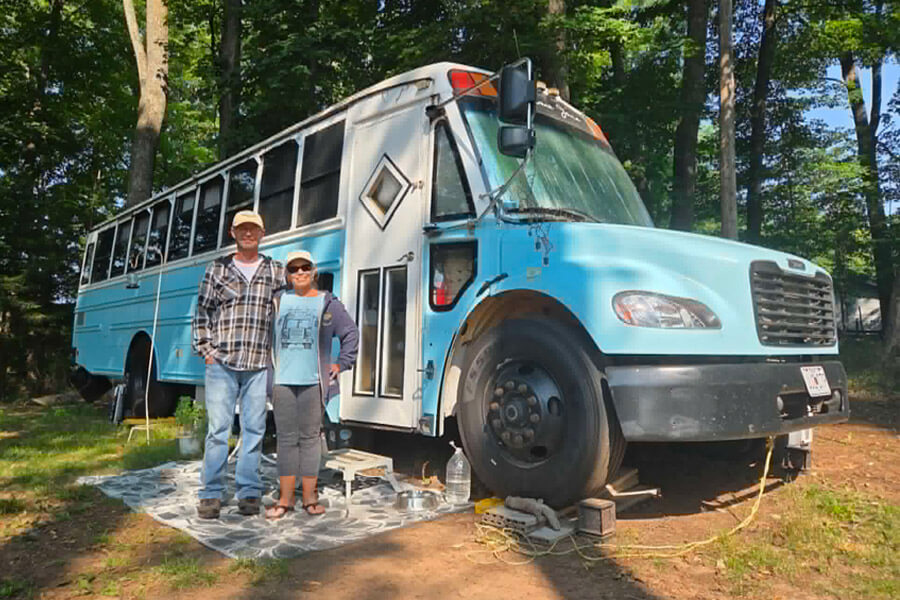
Susan Savage and Tad Mayfield did not spend years carefully planning their transition to full-time RVing. In fact, when they decided to change their lives, they didn’t even own an RV.
The couple was driving along a Missouri highway when they spotted a woman traveling in a converted school bus. Her hair was blowing in the wind and she was smiling from ear to ear.
Susan looked at Tad and said, “I’d live with you in a skoolie.”
Tad agreed.
That casual exchange started a dramatic transformation. They went home that night, crunched the numbers and called a realtor the next day. Within 31 days, their house, cars and possessions were gone.
“We didn’t even have a school bus yet,” Susan recalled.
They stayed with their son for about six weeks while searching for the right bus. Eventually, they found a partially converted school bus in Tennessee, spent two months working on it and hit the road.
Why They Chose Full-Time RV Living
Originally from Jefferson City, Missouri, Susan spent 29 years working as a social worker. Tad spent most of his career in the printing industry.
Susan admitted they were not particularly happy with the lives they had been living.
She was already retired, but Tad was still working long hours to maintain their home and everything that went with it. Susan wanted to travel, and her retirement income gave them enough financial flexibility to consider making a major change.
So, Tad quit his job and they started traveling.
Workamping was not initially part of their plan. In fact, they did not even know the opportunity existed.
Discovering Workamping by Accident
About six months into their travels, Susan and Tad were staying at McIntosh Woods State Park near Clear Lake, Iowa. A woman with the Iowa Department of Natural Resources asked whether they might be interested in camp hosting.
They had no idea what she was talking about.
The responsibilities were relatively simple. They would spend about 30 minutes each morning cleaning a restroom, then be available to answer questions from campers about the park and surrounding area.
After completing state and federal background checks, Susan and Tad accepted the opportunity.
“After that, we were like, ‘Oh my gosh, there’s a whole world out there of Workamping and camp hosting,’” Susan explained. “We just started searching for other positions because we enjoyed it so much.”
Camp hosting remains their favorite type of Workamping. For Susan, interacting with campers came naturally after nearly three decades as a social worker.
Exploring Different Types of Workamping Jobs
During four and a half years on the road, Susan and Tad have held positions at two state parks as well as private operations.
Their responsibilities have varied considerably. They have worked as camp hosts, performed maintenance, cooked, cleaned and painted cabins.
At the time of their interview, they were working at Island View Lodge in Mercer, WI, where 10 cabins sit along a lake in Wisconsin’s Northwoods.
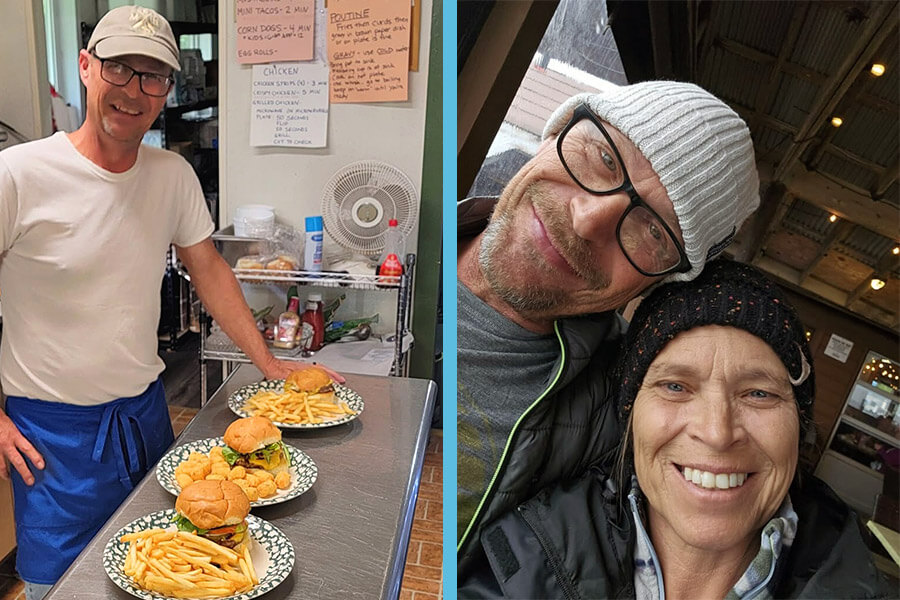
Tad was cooking in the lodge’s restaurant three days a week. Susan was babysitting the owner’s 2-year-old daughter on Fridays, and they both helped with cleaning.
Together, they worked about 25 hours per week, but the position also came with benefits beyond compensation. They received a full-hookup site as well as free firewood and ice. They also had access to a pontoon boat whenever they wanted to get out on the water.
However, the biggest benefit of Workamping for Susan and Tad cannot necessarily be measured in dollars. Workamping gives them time.
How Workamping Helps Them Become Part of a Community
Before Workamping, the couple would simply move from one destination to another. Instead, a Workamping position gives them an opportunity to remain in an area long enough to understand it.
“I really think what drew us into Workamping was to be able to stay somewhere longer,” Tad explained. “That allows you to get to know people and the community better.”
A Workamping position gives them a home base from which they can explore an entire region rather than simply visiting its most popular tourist attractions.
For Susan, the ability to experience different cultures and communities is especially important. She noted that life in northern Wisconsin is distinctly different from what they experienced while staying in Alabama.
“Getting to know a culture, community and people is important to us,” Susan explained.
Sometimes that means discovering traditions visitors might never know existed.
For example, Tad noted that Mercer’s annual Loon Day celebration is a major event in the community. Someone passing through for a few days might never understand its significance.
By staying for a season, Workampers have time to discover those experiences and develop relationships with people who live there.
Choosing the Destination Before the Workamping Job
Susan and Tad have developed a strategy for selecting Workamping positions.
Rather than searching for an interesting job and traveling wherever it happens to be located, they generally decide where they want to spend time first. Then they look for Workamping opportunities in that area.
Their larger travel strategy is equally simple.
“We follow 70-degree weather,” Susan said.
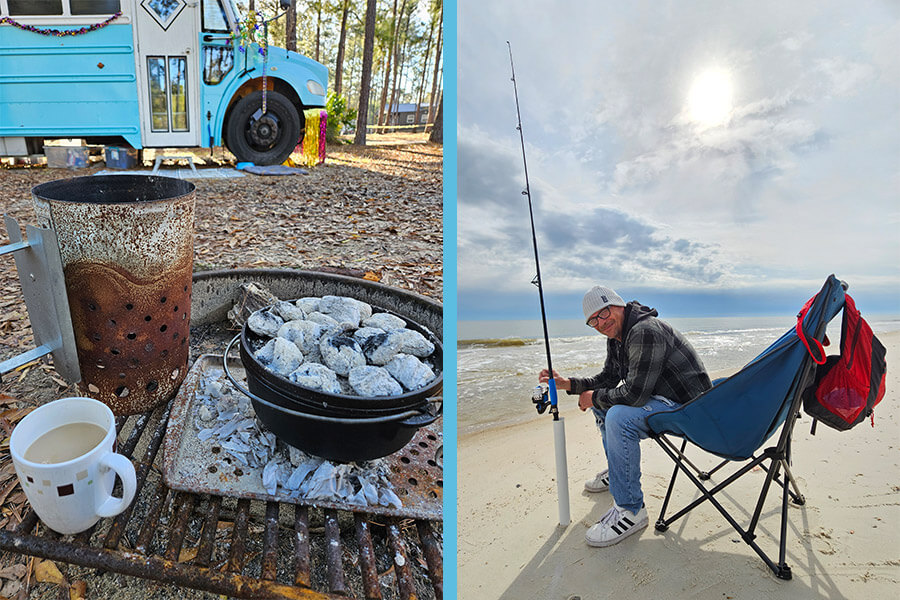
That approach has taken them around much of the country. They have spent a winter in Quartzsite, AZ, and traveled through New Mexico, Minnesota, Florida and Alabama as well as many places in between.
They plan to spend the upcoming winter on Dauphin Island in Alabama, but their schedule beyond that remains open.
“There’s so many opportunities out there,” Susan explained.
When Workamping Plans Don’t Go as Expected
As much as Susan and Tad enjoy their lifestyle, traveling and Workamping have not been without challenges.
Missing their four sons and five grandchildren is difficult. They make a point of returning to Missouri in spring and fall to reconnect with family and friends.
Mechanical problems can also disrupt even the best travel plans. At one point, their bus suffered a major breakdown in Kansas that forced them out of their home for two weeks.
Fortunately, they tow a Honda CR-V behind the bus, which Susan jokingly calls their “escape pod.”
They have also learned that Workamping jobs don’t always go according to plan.
On one occasion, Susan and Tad arrived at a campground for a position that had already been arranged, only to discover there was no work for them. A breakdown in communication between the corporate office and campground meant local managers did not even know they were coming.
Another Workamping position was canceled just two and a half weeks before they were scheduled to arrive.
Those experiences taught the couple one of their most important lessons about living and working on the road. Flexibility is essential because plans can change with little warning.
“You have to learn to pivot quickly,” Susan explained.
Always have a Plan B
For people considering Workamping, Susan’s first suggestion is not to spend forever wondering whether the lifestyle might work.
“If you’re to the point that you’re contemplating it, you need to do it,” she said
Susan wishes they had discovered Workamping earlier because knowing about seasonal employment opportunities would have allowed them to be more intentional when planning their first months on the road.
Even with the challenges they have experienced, she could not think of a reason to discourage someone from trying the lifestyle. However, she stressed the importance of being honest with potential employers about your skills and abilities.
“It’s very important to be authentic with them about what you can do and what you are able to do,” she explained.
Being upfront can help prevent misunderstandings about responsibilities and expectations after Workampers arrive.
Tad agreed that flexibility is one of the most valuable qualities a Workamper can develop.
“You may get somewhere and it just doesn’t work out,” he explained. “You’ve always got to have Plan B.”
Finding Freedom Through Workamping
Susan and Tad never had a carefully developed plan for how life on the road would unfold. They sold their home before they even had a school bus, and they discovered Workamping only after someone asked if they wanted to become camp hosts.
Four and a half years later, that willingness to embrace the unexpected remains a big part of how they travel.
Their approach is simple: Pick interesting places, find Workamping opportunities that allow them to stay awhile, get involved in the community and remain flexible when plans change.
Then, follow the 70-degree weather wherever it leads.
Listen to their full conversation on The Workamper Show podcast to hear more about their skoolie travels and Workamping experiences.



Leave a Reply